

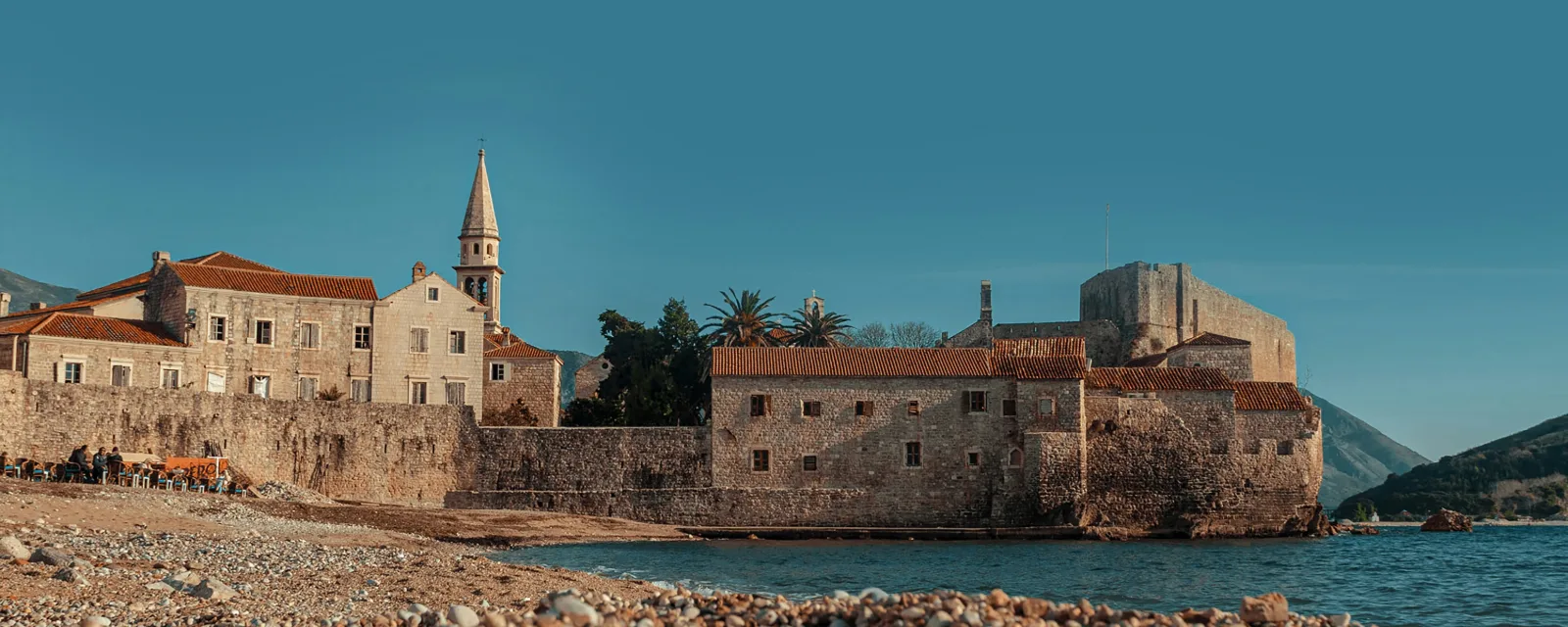
Budva
Budva is the most visited place on the Montenegrin coast, and in summer it doesn't sleep. The old town is small, walled and jutting out into the sea, and around it hotels, apartment blocks, clubs and kilometres of beaches with sunbeds have grown up. If you want buzz, music and people, you'll find more of them here than anywhere else on the Adriatic. If you want peace, you won't find it in the centre in mid-August. You only need to go a few kilometres further, though, towards Sveti Stefan and Petrovac, or come in June or September.
Things to do
You can see the old town in an hour. Walk the narrow streets to the square with three churches, climb the citadel and stroll along the walls. Right next to it, a path cut into the rock leads to Mogren, two pebble beaches below a cliff and the prettiest in Budva itself. Slovenska Beach is long and urban, with everything that goes with that. Jaz, three kilometres to the west, is wider and more open. Boats run to Sveti Nikola island, opposite the town, where the beaches are quieter. A promenade follows the sea to Bečići and Rafailovići, through a tunnel in the rock, and from there continues towards Pržno and Sveti Stefan.
Tips
If you can, avoid late July and the first half of August. Prices are at their highest, the roads are jammed and you have to hunt for a free spot on the beach. Sveti Stefan is a hotel and you can't enter without a reservation, but the view from the main road is free and at its best towards evening. At night the centre is loud until dawn, so if you want to sleep, choose somewhere away from the promenade. For dinner, drive to Pržno, a small fishing village with restaurants right on the beach. Above Budva, on the road to Cetinje, there are viewpoints over the whole riviera, so stop at one of them.
Did you know?
Budva is about 2,500 years old and among the oldest settlements on the Adriatic. According to Greek legend, it was founded by Cadmus, king of Thebes, who arrived here with his wife Harmonia on an ox-drawn cart. The old town was once an island, joined to the mainland by a sandbar. In the earthquake of 15 April 1979 it was almost destroyed, and it took years to rebuild it from old plans, house by house. The bronze ballerina on the rock near Mogren is the most photographed spot in town. Locals call Sveti Nikola island Školj, and tourists call it Hawaii.