

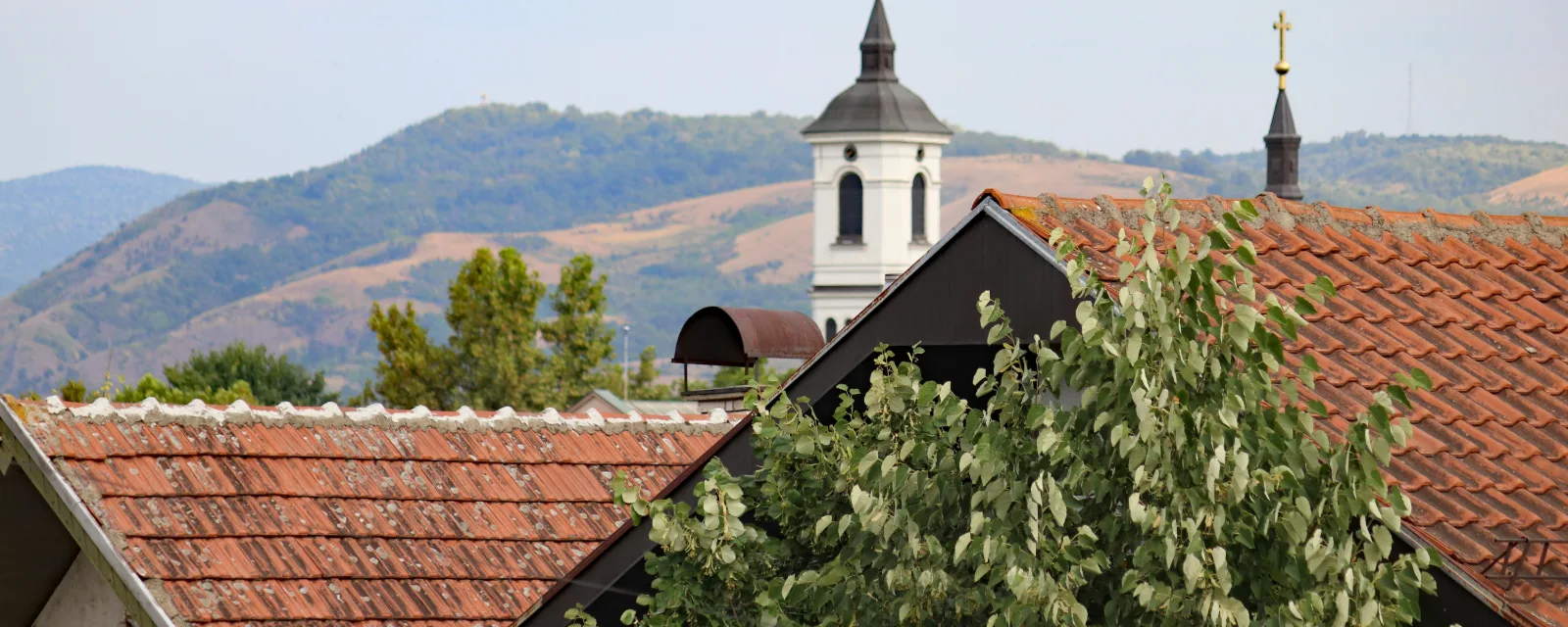
Kladovo
Kladovo is a small town on the Danube at the exit of the Đerdap Gorge, opposite Drobeta-Turnu Severin in Romania. It's about four hours' drive from Belgrade, and the last part of the route, through the gorge, is a trip in itself. The town is small and quiet, with a quay, a Danube beach and an old fortress on its edge. People come here for the river: for the Kazan, where the Danube squeezes between cliffs, for the Roman remains along the bank and for the fish served everywhere.
Things to do
The best experience is a boat ride through the Great and Small Kazan, the narrowest part of the gorge, where cliffs rise hundreds of metres above the water. From the river you can also see Trajan's Tablet, a Roman inscription carved into the rock, and on the Romanian bank the huge face of the Dacian king Decebalus. On the way to Kladovo, stop at Lepenski Vir, where a museum stands over a settlement about eight thousand years old. In town, visit Fetislam Fortress and the remains of the Roman fort of Diana. The Đerdap hydroelectric dam, about ten kilometres upstream, can be visited by appointment.
Tips
For a trip through the Kazan, arrange a boat in Kladovo or Tekija, and go in the morning, when the water is calm. Bring your passport if you want to cross the dam to the Romanian side. A narrow path leads to the Ploče and Kovilovo viewpoints, so wear trainers. At the restaurants along the Danube, try fish soup made with several kinds of fish, and catfish cooked in various ways. If you have time, drive to Negotin and the Rajac cellars, a village of stone wine cellars.
Did you know?
Trajan's Tablet was carved in the year 100, when the Roman emperor Trajan cut a road through the gorge. When the dam was built, the tablet was cut out of the rock and raised higher so that the water wouldn't drown it. Downstream from Kladovo you can see the remains of Trajan's Bridge, built around 105 by the architect Apollodorus of Damascus, which was the longest bridge in the world for more than a thousand years. Lepenski Vir was discovered by archaeologist Dragoslav Srejović in the 1960s, and because of the dam the whole excavation was moved about thirty metres higher. In the Kazan, the Danube is only about 150 metres wide in places.