

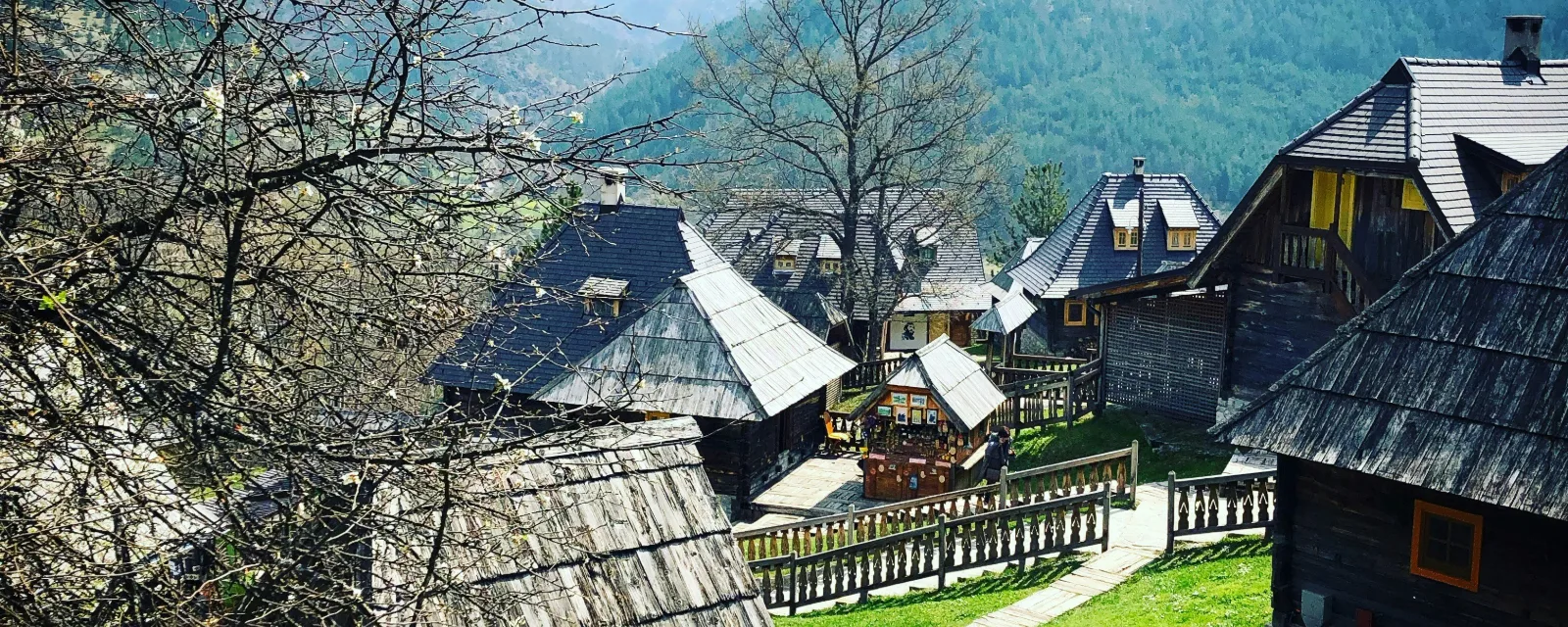
Mokra Gora
Mokra Gora is a valley between Zlatibor and Tara, right on the border with Bosnia, surrounded by wooded hills and meadows. Until about twenty years ago it was a quiet mountain village, and then two things put it on the map: the restored Šargan Eight railway and Drvengrad, a village of logs that film director Emir Kusturica built on a hill. Everything here is still modest and quiet, with a few ethno villages, family guesthouses and a stream running through the valley. People come for a day or two, usually with children.
Things to do
The Šargan Eight is a narrow-gauge railway that loops through tunnels and over bridges in the shape of a figure eight to climb a steep slope. An old train with wooden carriages runs from the station in Mokra Gora to Šargan Vitasi and back, and the ride takes about two and a half hours, with stops at viewpoints. Drvengrad, on Mećavnik hill, has wooden houses, a church, a cinema and streets named after famous people. From there you look out over the whole valley. In summer people hike in the nature park, and in winter they sledge and ski on the small slopes nearby. The village of Kremna is a few kilometres away.
Tips
In summer, buy your tickets for the Šargan Eight early, because they sell out quickly, and the trains don't run all year, so check the timetable. Sit on the right-hand side of the carriage for the better view. Drvengrad is nicer in the morning, before the tour buses arrive. Stay at a village guesthouse and eat what the hosts cook: dried ham, cheese, kajmak, lamb and pie. Mokra Gora combines easily with Zlatibor and Tara, so it's best to stay in one place and visit all three.
Did you know?
The Šargan Eight was part of the Belgrade–Sarajevo railway, which closed in 1974, and this section reopened for tourists in 2003. The route, about thirteen kilometres long, has around twenty tunnels and five bridges. Drvengrad was built for the film "Life Is a Miracle", and every January it hosts the Küstendorf film festival. Kremna is known for the Kremna Prophecy, predictions attributed to two 19th-century peasants, Mitar and Miloš Tarabić.