

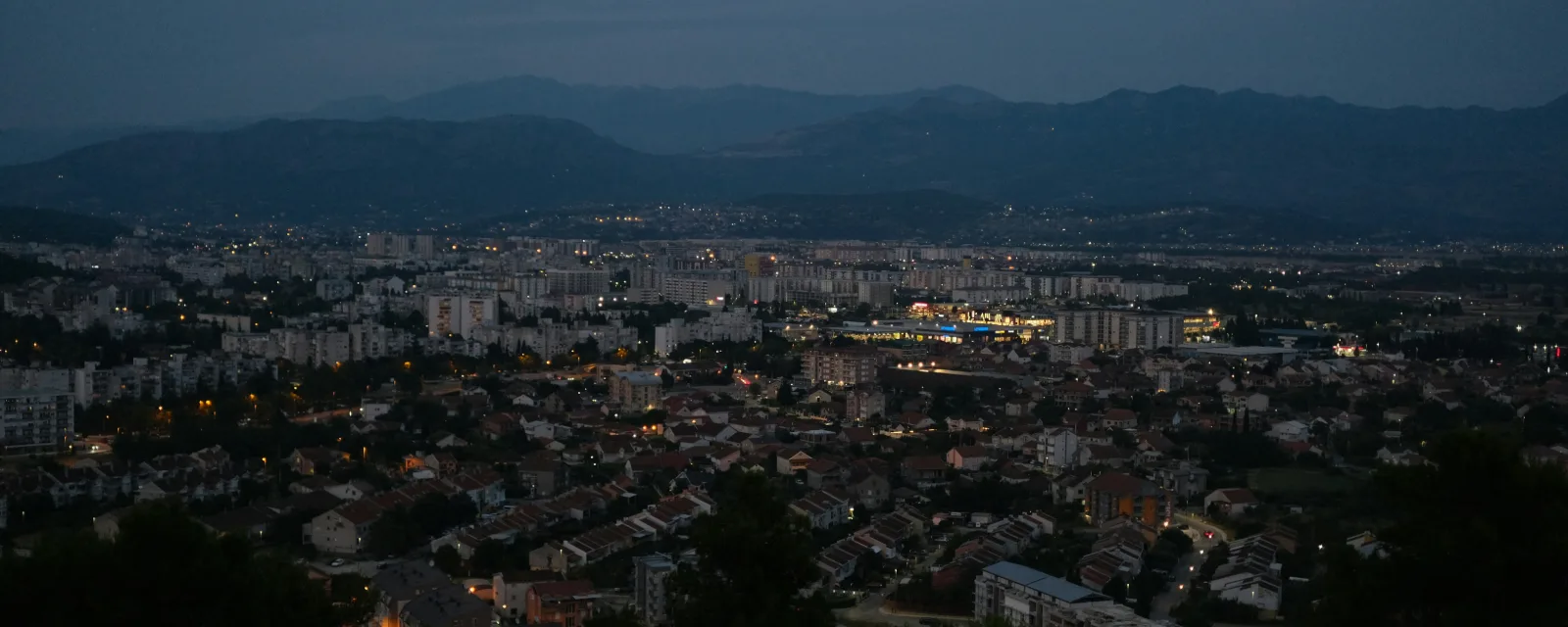
Podgorica
Podgorica is the capital of Montenegro, but it's not the reason people come to the country. Most travellers just pass through on their way to the coast or the mountains. Those who stay a day or two find a small, green, relaxed city where life happens on café terraces and two rivers run through the centre. Its greatest asset is its location. The sea, Lake Skadar, Ostrog, Cetinje and the Morača canyon are all an hour away or less, which makes Podgorica a good and inexpensive base for seeing the whole country.
Things to do
The oldest part of the city is Stara Varoš, with winding streets, low houses, two mosques and a clock tower from Ottoman times. From there you walk down to where the Ribnica flows into the Morača, with an old stone bridge and the remains of a fortress, and in summer people swim under the bridge. Across the river is the new centre, with a pedestrian street, Independence Square and the Millennium Bridge. Gorica hill, above the city, is where people go to walk and run through pine woods. Outside the city, the Šipčanik wine cellar is worth seeing, and above all Lake Skadar. From Virpazar, boats take you through water lilies and reeds, past islets with monasteries.
Tips
In summer Podgorica is one of the hottest cities in Europe, and at midday nobody moves unless they have to. Leave sightseeing for the morning and evening, and spend the middle of the day at the lake or by the Morača. In spring, while the water is high, see the waterfall on the Cijevna river, known as Niagara, and have lunch at the restaurant beside it. Ostrog Monastery, cut high into a cliff, is about an hour's drive away, and the last stretch of road is narrow and steep. At the table, order prosciutto and cheese kept in oil, carp or eel from the lake, and Vranac wine to go with it. Coffee on a terrace is an important part of the day here, so nobody rushes it.
Did you know?
From 1946 to 1992 the city was called Titograd. It was bombed more than seventy times in the Second World War and almost levelled, so today's Podgorica is mostly post-war. On the edge of the city lie the remains of Doclea, the Roman town that gave its name to Duklja, the medieval state in this area. The Šipčanik cellar is in a tunnel more than three hundred metres long, where the army once hid aircraft. The vineyard on Ćemovsko Polje is one of the largest single-plot vineyards in Europe. Lake Skadar, half an hour from the city, is the largest lake in the Balkans and home to the rare Dalmatian pelican.