

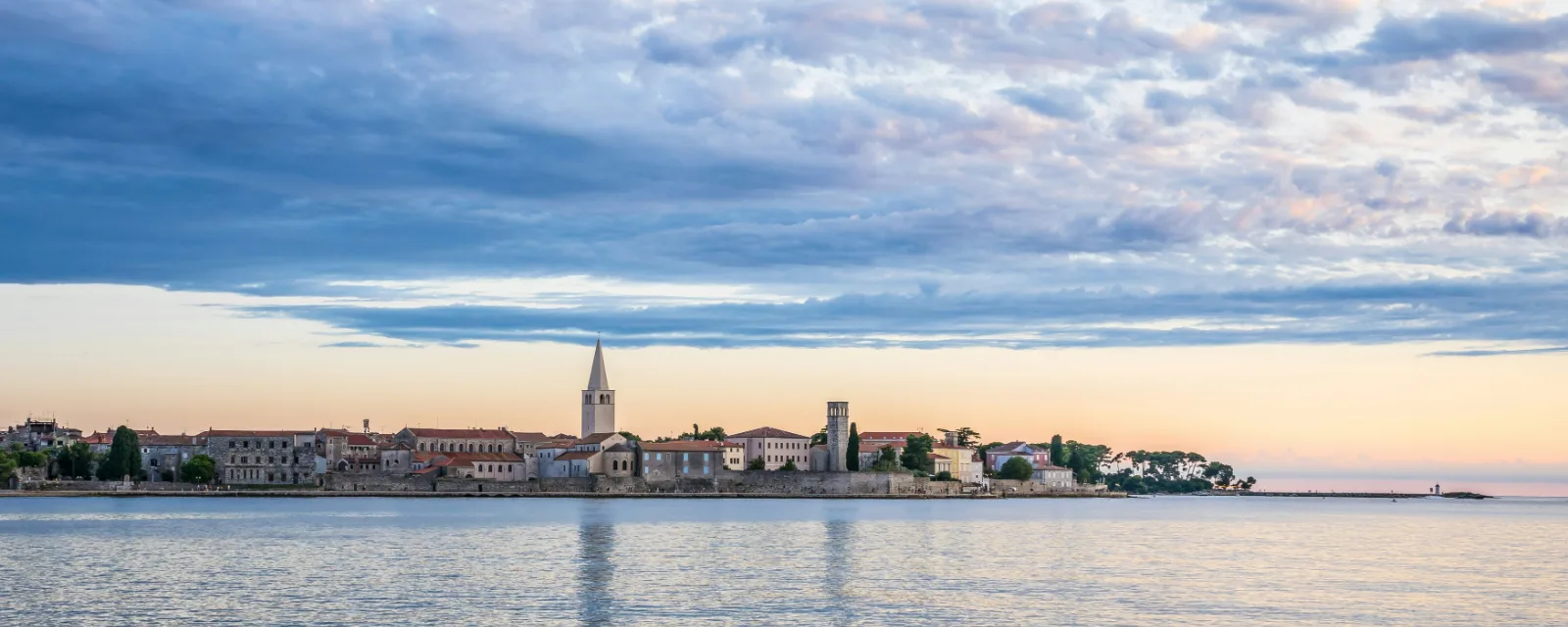
Poreč
Poreč is a town on the west coast of Istria that tourists have been coming to for more than a hundred and fifty years. The old part occupies a small peninsula and still keeps the plan the Romans gave it: two straight main streets and a square where the forum used to be. Everything around it is set up for holidays. There are pine woods, paved beaches, cycle paths and sports grounds. Poreč isn't a place for adventure but for an easy summer break with everything close at hand, which is why families choose it.
Things to do
The most important thing to see is the Euphrasian Basilica, on the edge of the old town. Go into the church for the golden mosaics in the apse, then walk around the atrium, the baptistery and the bishop's palace, and climb the bell tower. Afterwards, stroll down Decumanus, the main street lined with Gothic and Baroque palaces, to Marafor Square, where you can see the remains of Roman temples. A seaside promenade leads south from the centre and reaches the Plava and Zelena Laguna bays in about an hour on foot. You can stop at any beach along the way. Children will love the water park and the tourist train, and for a cloudy day there's Baredine Cave, with its underground chambers and the olm, a cave salamander.
Tips
A boat from the waterfront takes five minutes to reach St Nicholas Island, where swimming is quieter and the view of the old town is at its best. Rent a bike, because the surroundings are flat and there are paths everywhere. If you want more, try a section of the Parenzana, an old railway route that runs through tunnels and over viaducts. One afternoon, drive inland to Motovun or Grožnjan, small towns perched on hilltops. Try the truffles there. Dinner at a konoba in the villages behind Poreč is usually better and cheaper than in the centre. Have it with Malvasia, the white wine of this region.
Did you know?
The Euphrasian Basilica was commissioned by Bishop Euphrasius in the mid-6th century, and its mosaics rank among the finest surviving Byzantine mosaics in Europe. It has been a UNESCO World Heritage Site since 1997. As a Roman colony the town was called Parentium, and the main streets still bear their Roman names, Decumanus and Cardo. The narrow-gauge Parenzana railway linked Poreč with Trieste from 1902 to 1935, carrying wine, oil and salt. The first tourist guidebook to Poreč was printed as early as 1845.