

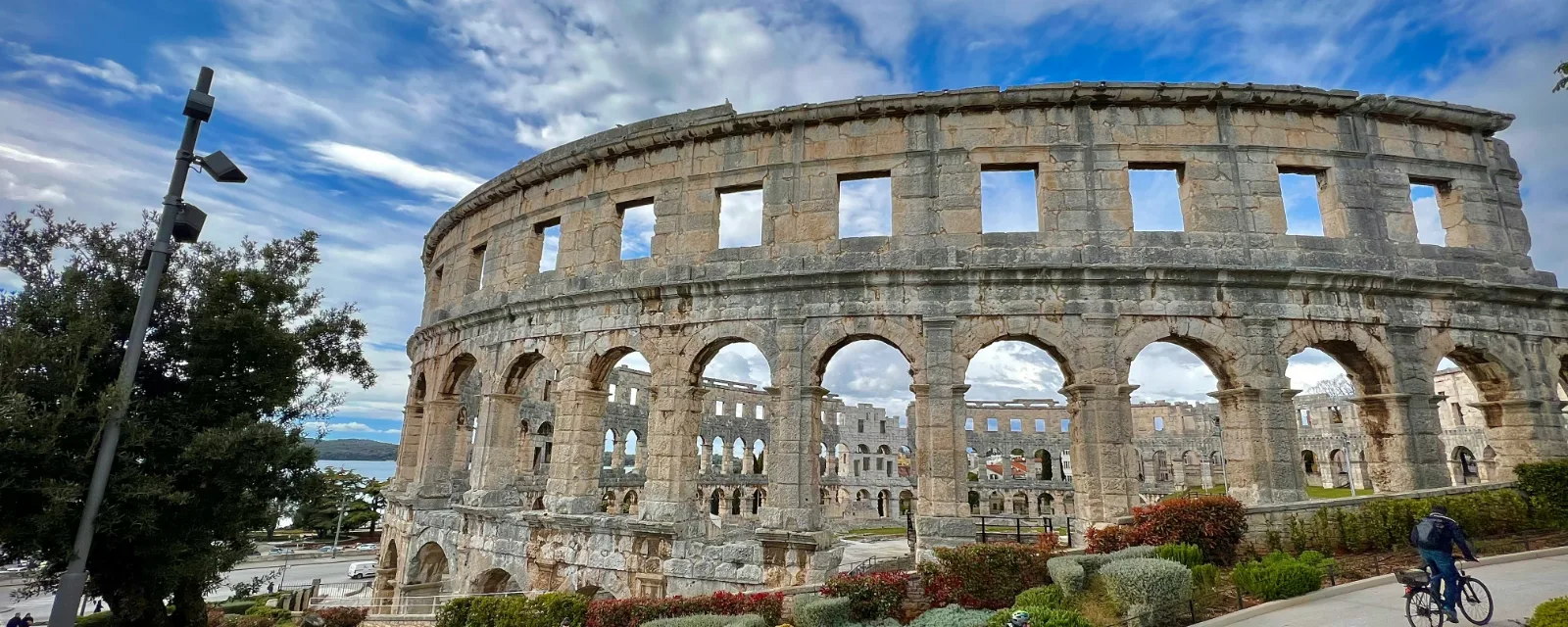
Pula
Pula is the largest city in Istria and a place where antiquity is part of daily life. People park and wait for the bus next to a Roman amphitheatre, walk under a two-thousand-year-old arch on their way to the shops, and drink coffee on the Forum, which was the main square in Roman times too. The city is also a port and a shipyard, so it isn't scrubbed clean like Rovinj or Poreč. That's exactly why it feels real. The sea and the beaches are a little way from the centre, on the Verudela and Stoja peninsulas and in the nearby villages.
Things to do
Everything starts with the Arena. Go inside, sit on the stone tiers and go down to the underground rooms, where there's an exhibition on olive oil and wine in ancient times. From there it's a walk to the Arch of the Sergii, then along the main street to the Forum and the Temple of Augustus. Above the centre stands the Venetian fortress with a view of the whole bay, and beneath it runs Zerostrasse, tunnels from the First World War that let you cross from one end of town to the other. For swimming, drive to Cape Kamenjak, wild and protected, with rocks, coves and clear water. From nearby Fažana a boat crosses to the Brijuni islands in fifteen minutes.
Tips
Check what's on at the Arena while you're here. A concert or a film under the open sky, between walls two thousand years old, is an experience you can't repeat in many places. Go to the market in the morning: in the old hall of iron and glass, the fish market is downstairs and people drink coffee upstairs. Bring water, food and shoes for the rocks to Kamenjak, because there's almost no shade and hardly any shops. After dark, walk to the waterfront and look at the shipyard cranes, which light up in colour every hour. For dinner, try Istrian prosciutto, maneštra soup and homemade pasta with truffles.
Did you know?
The Pula Arena was built in the first century, at the same time as the Colosseum in Rome, and held more than 20,000 spectators. It's among the six largest surviving Roman amphitheatres and the only one with all four side towers still standing. In the 16th century the Venetians wanted to take it apart and ship it stone by stone to Venice, but Senator Gabriele Emo talked them out of it. As a young man, James Joyce taught English in Pula for half a year, and today his bronze figure sits in a café next to the Arch. Austria-Hungary had its main naval port here, which is why the city is ringed by forts.