

Sarajevo
Sarajevo lies in the narrow valley of the Miljacka, with hills rising right behind the last houses. Within a few hundred steps you go from an Ottoman bazaar, with its shops, mosques and the smell of ćevapi, to an Austro-Hungarian street with Viennese-style cafés. The city has been through a great deal and doesn't hide it, yet it welcomes visitors with the warmth and humour its people are known for. Here you sit for a long time, talk a lot and hurry nowhere.
Things to do
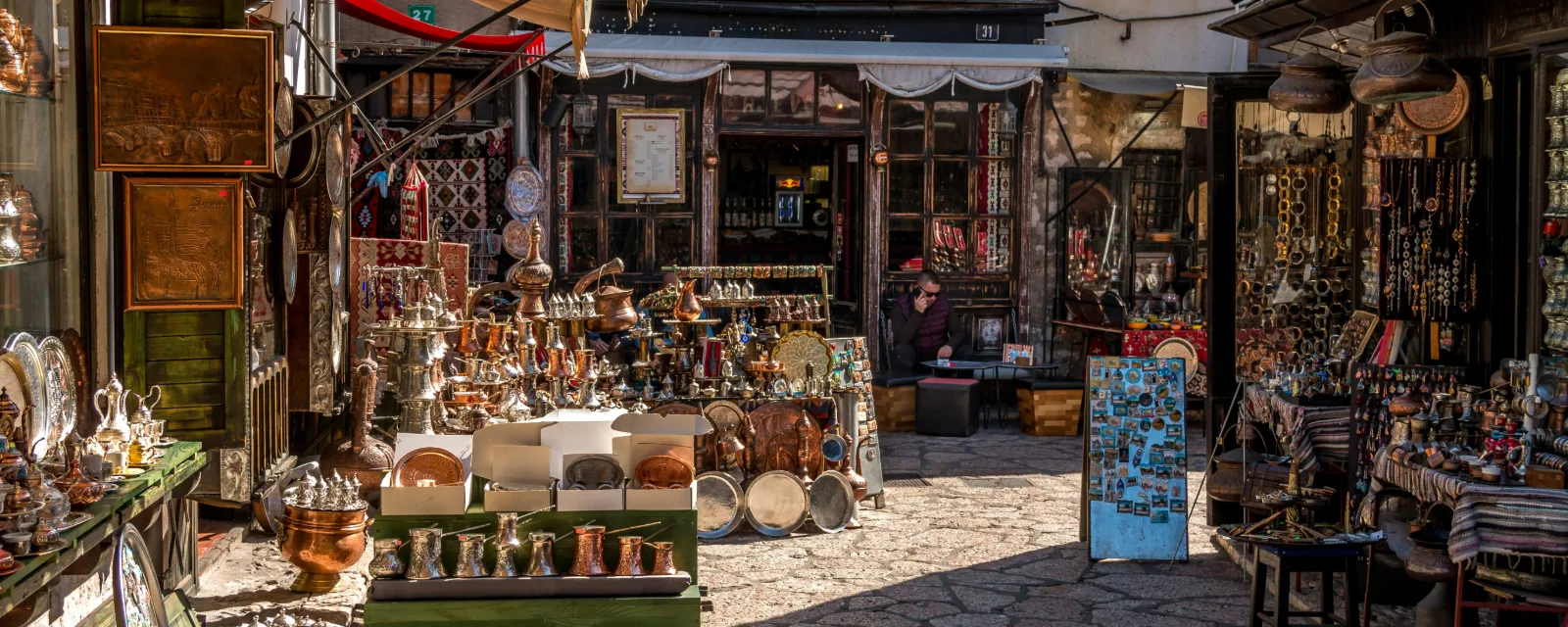
Everything starts in Baščaršija, at the Sebilj, a wooden fountain always surrounded by pigeons. Walk down Kazandžiluk, the street where craftsmen still hammer copper today, and step into the courtyard of the Gazi Husrev-beg Mosque. From there it's a few minutes to the City Hall on the bank of the Miljacka and to the Latin Bridge, where the heir to the Austro-Hungarian throne was killed in 1914. Ferhadija Street leads west, past the cathedral and the Eternal Flame. A cable car from the old part of town takes about ten minutes to reach Mount Trebević, where you can walk along the concrete Olympic bobsleigh track, covered in graffiti. In Ilidža, at the end of the tram line, a long avenue of plane trees leads to Vrelo Bosne, the spring of the river Bosna.
Tips
Eat ćevapi in Baščaršija, in somun flatbread, with onion and without cutlery. In Sarajevo burek means meat only, and everything else is pita: with cheese, with spinach, with potato. Bosnian coffee arrives in a džezva pot, with a sugar cube and Turkish delight, and is drunk slowly. Before sunset, climb to the Yellow Bastion for a view of the whole city. Make time for the Tunnel of Hope near the airport and the War Childhood Museum, to understand what the city lived through in the 1990s. Sarajevo is also a good starting point for Jahorina and Bjelašnica, both less than an hour's drive away.
Did you know?
Where Ferhadija Street turns into Sarači, there's a line on the pavement with the words "Sarajevo, Meeting of Cultures". Look one way and you see Vienna, the other way Istanbul. A mosque, a Catholic cathedral, an Orthodox church and a synagogue stand within a few minutes' walk of each other. The clock on the tower by the Bey's Mosque keeps time the old way, with the day starting at sunset, so it's regularly adjusted by hand. Sarajevo got its electric tram in 1895, among the first cities in Europe, and hosted the Winter Olympics in 1984. The tunnel under the airport runway, about 800 metres long, was the city's only link to the outside world during the siege.