

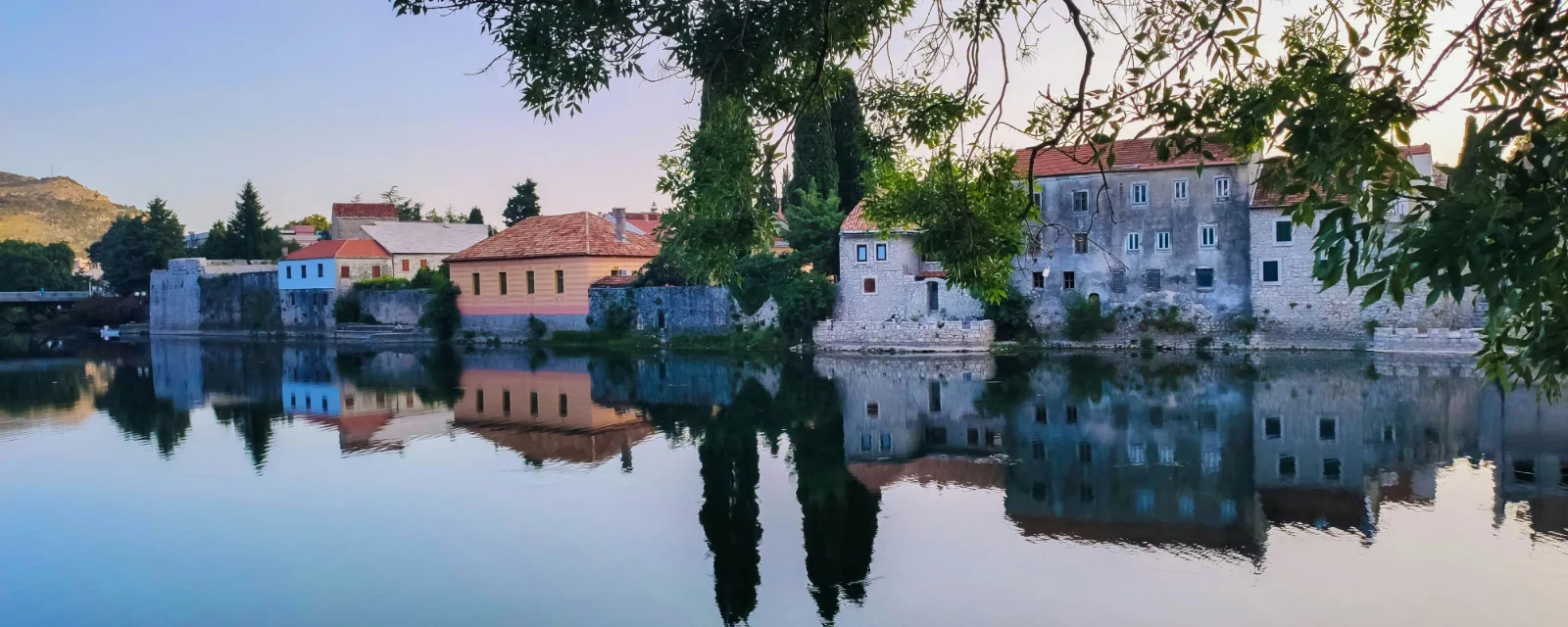
Trebinje
Trebinje is a small town in the far south of Herzegovina, on the Trebišnjica river, half an hour's drive from Dubrovnik and the sea. It gets almost as much sun as the coast, and far more peace. The whole life of the town unfolds on a square under enormous plane trees, where there's a market in the morning and people spend the rest of the day sitting in the shade over coffee and a glass of wine. All around are hills with vineyards, stone bridges and monasteries. Trebinje is a town where you quickly feel at home, which is why many people stay longer than they planned.
Things to do
Start the day on the square, with coffee under the plane trees, then walk around the market, where farmers sell cheese aged in sheepskin, honey, figs and rakija. A gate leads into the Old Town, Kastel, a small Ottoman fortress with a mosque, a museum and taverns by the river. A promenade runs along the Trebišnjica, and a little upstream stands the Arslanagić Bridge, a slender stone bridge from the 16th century. You can drive or walk up Crkvina hill to the Hercegovačka Gračanica church, with a view of the whole town, the river and the plain. A few kilometres away is Tvrdoš Monastery, with a wine cellar several centuries old, and around town there are wineries that welcome visitors.
Tips
Come to the market on a Saturday, when it's at its biggest, and buy directly from the people who produced the food. At a winery or on the square, try Žilavka, a white, and Vranac, a red, the wines of this region. In summer the temperature goes above 35°C, so spend the middle of the day by the river or at the town pools. Accommodation and food are noticeably cheaper than in Dubrovnik, so many people sleep here and go to the sea for the day. Bring your passport for the border and expect queues in season. Before you leave, walk through the park to the monument to Njegoš, a gift to the town from Jovan Dučić.
Did you know?
The Arslanagić Bridge was built in 1574 on the orders of Mehmed Pasha Sokolović. When a reservoir was created in the 1960s, the bridge was taken apart, the stones were numbered and it was rebuilt a few kilometres downstream. The poet and diplomat Jovan Dučić was born in Trebinje and died in America in 1943. He wanted to rest in his home town, so in 2000 his remains were moved to Hercegovačka Gračanica, built on the model of Gračanica Monastery in Kosovo. Dučić used to send the town sculptures and monuments from the cities where he served. The Trebišnjica is a sinking river, disappearing underground several times on its way to the sea.