

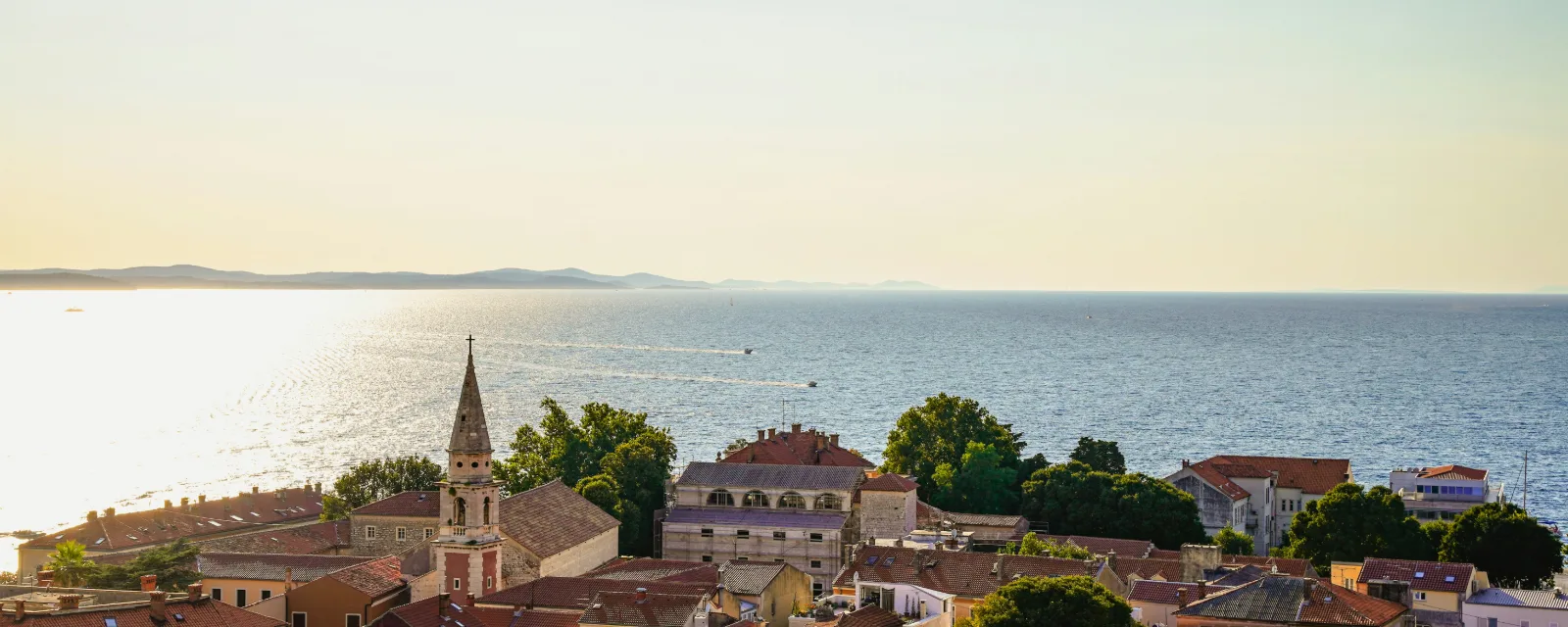
Zadar
Zadar is a city on a peninsula in northern Dalmatia, with an old core ringed by walls and the sea on three sides. It has three thousand years of history, and the old town is lively, full of students and cafés, not just an open-air museum. What people remember most about Zadar today is the sunset on the waterfront, to the sound of the Sea Organ played by the sea itself. The city is also an excellent base for the islands, Nin, the Kornati, Krka and Plitvice.
Things to do
Walk to the tip of the peninsula, to the Sea Organ, steps by the sea beneath which the waves make sounds through pipes, and to the Greeting to the Sun, a circle of glass panels that lights up in colour at night. On the Forum, the largest Roman square on the eastern Adriatic, stands St Donatus' Church, round and over a thousand years old. Enter the old town through the Land Gate, and on Five Wells Square look at the old cisterns. The barkajoli, rowers in small boats, still ferry people across the harbour for a couple of euros. Boats and ferries from Zadar go to Ugljan, Pašman and Dugi Otok.
Tips
Get to the waterfront by the Sea Organ at least half an hour before sunset, sit on the stone steps and stay until the Greeting to the Sun lights up. For a swim in town, go to Kolovare or Borik. Set aside a day for Nin, with sandy beaches, healing mud and the smallest cathedral in the world, and one for Dugi Otok and Telašćica nature park. At the market, buy Pag cheese and figs, and as a souvenir a bottle of maraschino. On summer evenings the old town is packed, so book dinner.
Did you know?
The Sea Organ was designed by architect Nikola Bašić and opened in 2005, and the Greeting to the Sun, by the same architect, in 2008. St Donatus' Church was built in the 9th century on the remains of the Roman forum, and pieces of Roman columns and altars can be seen in its foundations. Zadar's Venetian defence system was added to the UNESCO World Heritage List in 2017. Maraschino, a liqueur made from marasca cherries, has been made in Zadar for centuries and was served at European royal courts.