

Zagreb
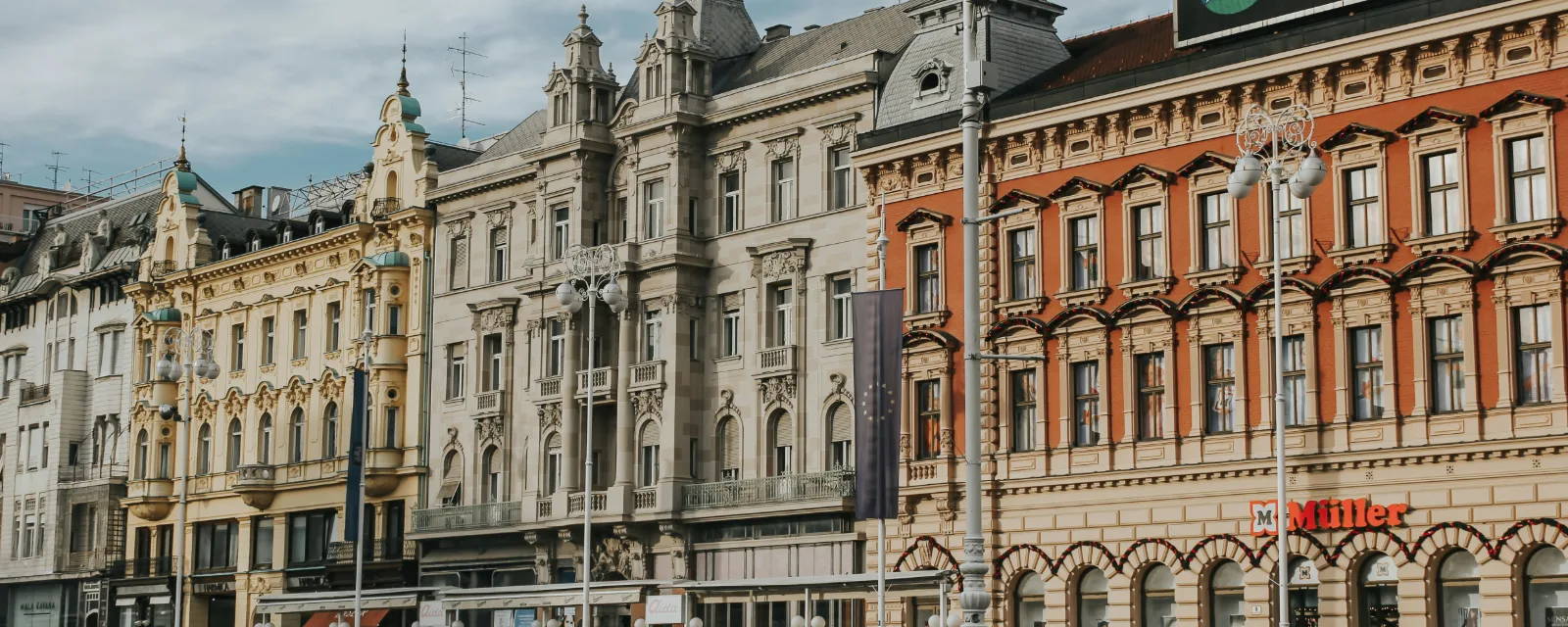
Zagreb is a city on a human scale. It's big enough to have everything a capital should have, and small enough that you can walk from one end of the centre to the other. The Upper Town is medieval and quiet, with cobbles and gas lamps. The Lower Town is Austro-Hungarian, with straight streets, yellow facades, parks and blue trams. People here care a lot about order and about their coffee, which on Saturday mornings they drink in the centre, nicely dressed, in a ritual called špica. The city is at its best in spring and in December.
Things to do
Start from Ban Jelačić Square and walk up to Dolac market, under its red umbrellas. From there it's two minutes to the cathedral on Kaptol and the same to Tkalčićeva, a street of cafés where a stream once ran. The Stone Gate, where candles are always burning, leads into the Upper Town. Here you'll find St Mark's Church with its roof of coloured tiles, Lotrščak Tower and the Museum of Broken Relationships. Come back down by funicular or by the steps. See the Lower Town along the Green Horseshoe, a chain of parks and squares with museums, the theatre and the Botanical Garden. For an afternoon outdoors there's Maksimir Park, Lake Jarun and Sljeme, reached by cable car.
Tips
Be at Lotrščak at noon sharp, but not too close, because the cannon really does boom. Go to Dolac before ten, while the stalls are full, and buy cheese and cream from the kumice, the village women from around the city. Try štrukli, baked with cheese and cream, and for lunch turkey with mlinci flatbread. A tram ticket is cheap, but in the centre you'll hardly need one. It's also worth going to Mirogoj, a cemetery with long ivy-covered arcades that looks more like a park. In December the whole centre is one big Christmas market, with an ice rink, mulled wine and sausages, so book your room in good time.
Did you know?
Zagreb grew out of two settlements on neighbouring hills, Gradec and Kaptol, which quarrelled for centuries. The bridge where they fought was called the Bloody Bridge, and today a short street bears that name. The funicular has been running since 1890, and its 66-metre track is one of the shortest in the world. The Grič cannon has marked noon since 1877. More than two hundred gas lamps still burn in the Upper Town, lit by hand every evening by lamplighters. In Zagreb in 1906 Slavoljub Penkala patented the mechanical pencil, and the necktie comes from a scarf worn by Croatian soldiers in the 17th century.