

Brač
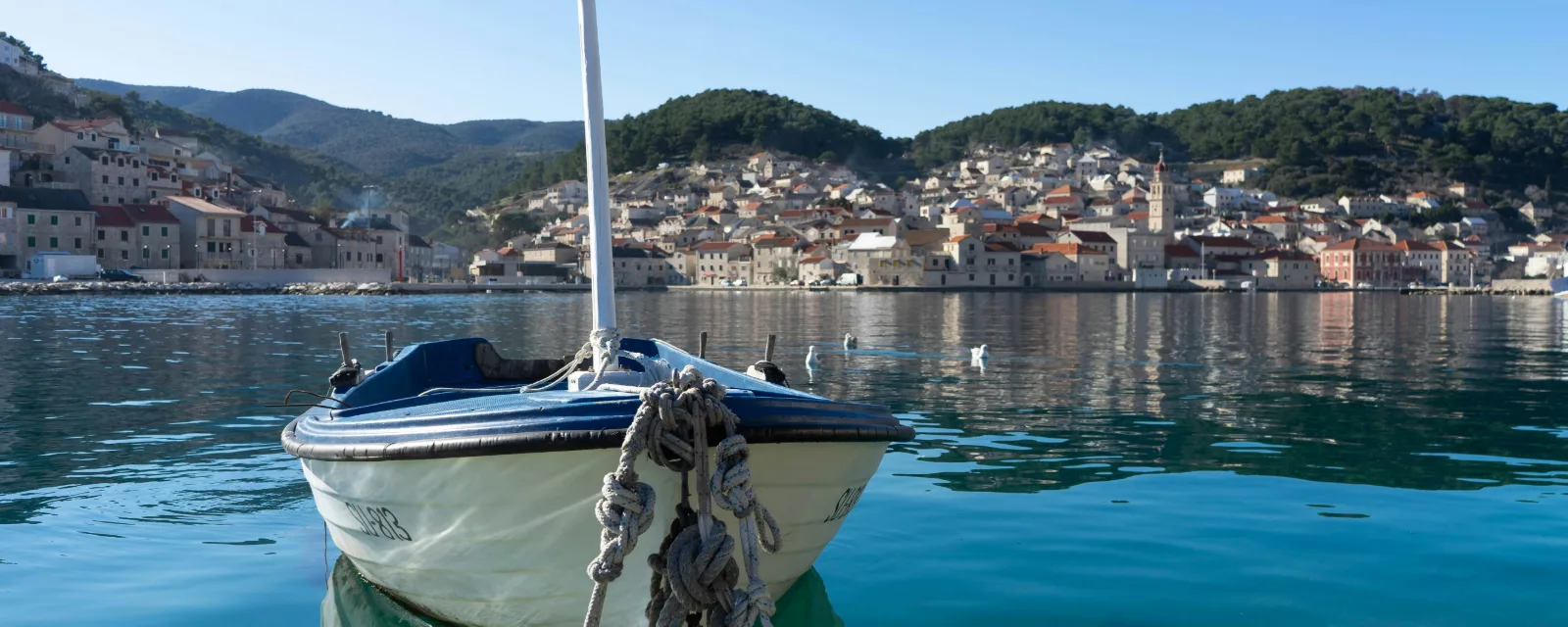
Brač is the largest island in Dalmatia and the easiest to reach: the ferry from Split to Supetar takes about fifty minutes and runs several times a day. Most visitors head straight for Bol and Zlatni Rat beach, and often see nothing else. Yet the island is big and varied. Along the coast there are small harbour towns, while the interior is a stony plateau of dry-stone walls, olive trees, sheep and villages where time passes slowly. Brač is also an island of stone, white and hard, and everything here is built from it, from houses to field walls.
Things to do
Zlatni Rat is worth seeing, even in a crowd. It's a pebble spit reaching far out into the sea, with pine woods behind it and a strong afternoon wind that brings out the windsurfers and kitesurfers. From Bol, by car or on foot in about two hours of climbing, you reach Vidova Gora, where you see Zlatni Rat from above, with Hvar, Vis and the open sea beyond. Blaca Hermitage, a former monastery under a cliff on the south side of the island, takes half an hour's walk along a rocky path, but it's one of the most unusual places on the Adriatic. In Pučišća, on the north coast, there's a stonemasonry school you can visit. Supetar, Sutivan and Milna are pleasant places to stroll and swim without the crowds.
Tips
You need a car or a scooter on Brač. Without one you're stuck in a single place, and the best things are scattered all over the island. Go to Zlatni Rat early in the morning or late in the afternoon, and spend the middle of the day in the shade or on one of the smaller beaches around Bol. Stop in Škrip, the oldest settlement on the island, for the museum in the old tower and the oil mill where you can taste olive oil. For lunch, find a konoba inland and order lamb cooked under a peka lid. The more adventurous can try vitalac, lamb offal on a spit. Take home cheese, oil and varenik, a thick grape syrup.
Did you know?
The tip of Zlatni Rat moves. Depending on the wind and the currents, it bends now to the east, now to the west. At 778 metres, Vidova Gora is the highest point on any Adriatic island. Diocletian's Palace in Split and the cathedrals in Šibenik and Trogir were built from Brač stone. It's said to be in the White House in Washington too, though there's no firm proof of that. Blaca Hermitage was founded in the 16th century by Glagolitic priests. The last of them, Father Nikola Miličević, was an astronomer, and his telescope is still kept there. The school in Pučišća teaches students to work stone by hand, just as it did a hundred years ago.